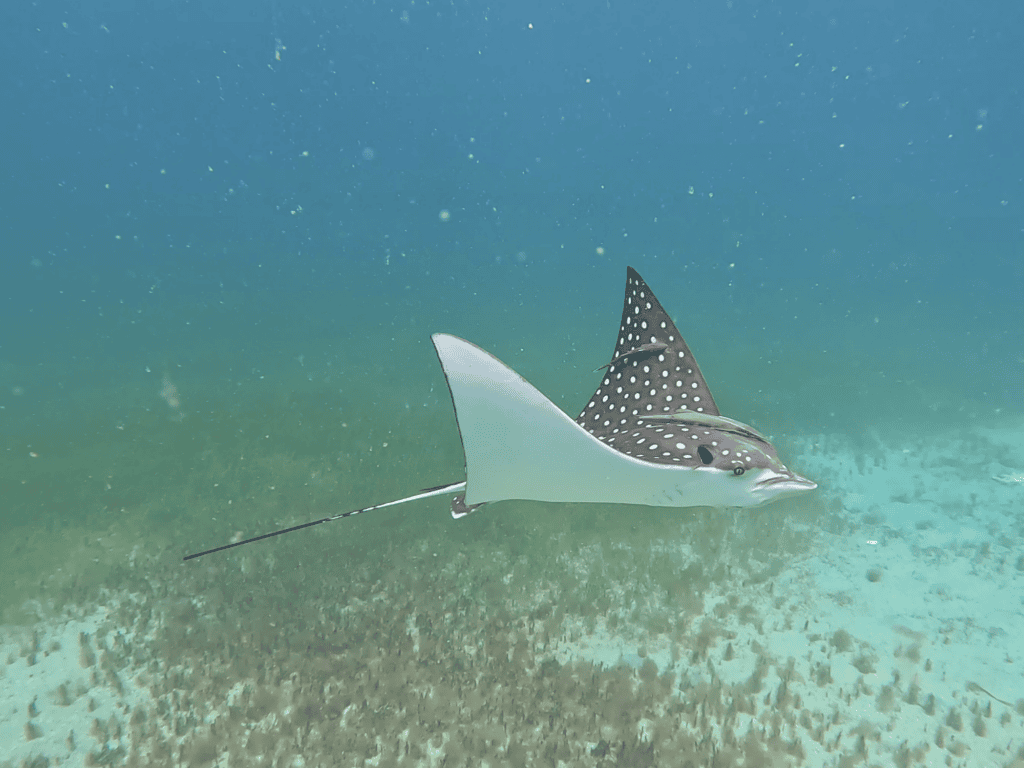
A Caribbean spotted eagle ray can turn an already memorable reef visit into the moment everyone talks about back on the boat. One second, you are following a coral ledge or watching a turtle browse the seagrass. The next, a broad-winged ray glides through blue water with almost no effort, its white spots flashing against a dark back. Around Sint Maarten, sightings are never guaranteed, but that surprise is part of what makes them special.
The Caribbean spotted eagle ray is a large, graceful ray recognized by its dark blue-gray to black upper surface, covered in bright white spots and rings. Its long, slender tail can make the animal look even larger as it passes. From below, the pale belly and pronounced, pointed wing tips create a silhouette that is hard to mistake once you have seen one.
Unlike a stingray that often rests on the seafloor, eagle rays spend much of their time swimming through the water column. Their powerful pectoral fins move in a slow, birdlike rhythm, which is where the common name comes from. They may cruise alone, travel in pairs, or occasionally appear in small groups.
Adults can have an impressive wingspan, often several feet across. That size, combined with their speed and calm movement, can make a close encounter feel almost unreal. Still, the right response is simple: enjoy the view, stay composed, and give the ray room to choose its own path.
Eagle rays use a mix of reef edges, sandy channels, seagrass areas, and open water near healthy reef systems. They are often on the move, so the best places to see them are not always the sites with the most coral or the clearest water. A ray may be cruising between feeding areas, passing over a wreck, or crossing a sandy bottom alongside a reef. We can see them scuba diving on any of our dive sites, from our shallow training dive site at Little Bay, to our Man of War Shoal Marine Park sites, to The Bridge and Gregory wreck sites along the South West coast.
For snorkelers, calm water and good surface visibility improve the odds of spotting the distinctive shape below. Small clouds of sand can indicate a feeding ray. Divers have an advantage because they can move slowly along reef contours and scan farther into the blue. Even then, a sighting depends on conditions, season, site activity, and pure island luck.
The best approach is not to fixate on finding one species. Slow down and look outward during a dive. Scan the sand, the reef line, and the water above you. This habit also helps you notice turtles, barracuda, reef sharks, schools of jacks, and the smaller reef life that makes every underwater outing worthwhile.
A spotted eagle ray is most often confused with a southern stingray when viewed from a distance. The difference is usually movement and body shape. Southern stingrays are rounder and commonly rest or feed directly on the sand. Eagle rays have a more angular, wing-shaped outline and are far more likely to be actively gliding through open water.
They can also be mistaken for manta rays by newer divers, especially when visibility is limited. Mantas are much larger, have broad forward-facing cephalic fins near the mouth, and do not have the long whip-like tail of an eagle ray. In the Caribbean, a spotted eagle ray is the far more likely encounter.


These rays are not simply passing visitors. They are active predators that use their flattened snouts and strong jaws to find and crush prey such as mollusks and crustaceans. When an eagle ray feeds over sand, it may leave small pits behind as it searches beneath the surface.
That feeding behavior is part of a healthy marine food web. Rays help shape populations of bottom-dwelling animals, while larger predators may prey on rays at different life stages. Their presence is one more sign that reef, sand, and seagrass habitats are connected rather than separate underwater worlds.
Eagle rays also reproduce relatively slowly compared with many smaller fish. That makes mature animals and their habitats worth protecting. A ray that appears relaxed around people is not an invitation to get closer. Respectful wildlife encounters reduce stress on the animal and help preserve the behavior that makes a natural sighting so rewarding.
The most memorable ray encounters happen when people do less, not more. If one approaches, hold your position or continue moving slowly in the direction your guide has planned. Keep your arms close, control your fins, and let the ray decide whether to pass nearby or turn away.
Never touch, chase, feed, corner, or attempt to swim in front of an eagle ray. Like other rays, it has a defensive tail spine and should always be treated with respect. The practical safety concern is not that eagle rays seek conflict. They do not. Problems arise when wildlife feels trapped, startled, or handled.
For groups, spacing matters. A cluster of divers racing toward a ray will usually end the encounter. A calm group that remains low, quiet, and predictable has a better chance of watching it glide naturally across the site.
Eagle rays are fast enough to challenge even experienced underwater photographers. The temptation is to chase the shot, but that usually produces a stressed animal, poor buoyancy, and a tail-end photo. Instead, watch the ray’s direction and position yourself only if you can do so without cutting it off.
A wide-angle approach works best when a ray comes close. Include blue water, a reef edge, or a diver at a respectful distance to show the ray’s scale. If the animal is farther away, take the record shot and then put the camera down for a few seconds. Seeing the animal clearly is often better than spending the entire encounter looking through a screen.
Good buoyancy is the real camera skill here. Avoid kicking up sand, stay off the reef, and never rest a hand or fin on coral to steady yourself. The photo is not worth damaging the habitat that supports the wildlife you came to see.
A Caribbean spotted eagle ray is one of those animals that reminds us why good dive practices are not just rules. Reef-safe sun protection, secure equipment, careful anchoring practices, and keeping distance from wildlife all help protect the places rays depend on.
Snorkelers and first-time divers can participate confidently with proper briefings, fitted gear, and a guide who knows how to manage a group around marine life. Certified divers should bring the same discipline they use on any reef: check buoyancy before descending, monitor air and conditions, and follow the local plan rather than pursuing a sighting.
As a PADI 5-Star Dive and ECO Center, The Scuba Shop SXM brings that balance of adventure and stewardship to guided island experiences. The goal is not to manufacture wildlife moments. It is to create safe, well-managed opportunities to meet the Caribbean on its own terms.
If an eagle ray appears on your next snorkel or dive in Sint Maarten, give it space, take a breath, and watch the way it moves. A few quiet seconds with a wild ray can stay with you far longer than any rushed close-up ever could.